Ayat al-Kursi is al-Baqarah 2:255, the verse that opens «اللَّهُ لَا إِلَٰهَ إِلَّا هُوَ الْحَيُّ الْقَيُّومُ», "God, there is no god but He, the Ever-Living, the Sustainer". It is named for the word Kursi, the Seat or Footstool, in its middle, and an authentic hadith calls it the greatest verse in the Qur'an. On a wall it is usually hung in the majlis or living room, at eye level or above; written in full it is long, so it needs A2 or larger to stay legible.
Ayat al-Kursi in full
«اللَّهُ لَا إِلَٰهَ إِلَّا هُوَ الْحَيُّ الْقَيُّومُ ۚ لَا تَأْخُذُهُ سِنَةٌ وَلَا نَوْمٌ ۚ لَهُ مَا فِي السَّمَاوَاتِ وَمَا فِي الْأَرْضِ ۗ مَنْ ذَا الَّذِي يَشْفَعُ عِنْدَهُ إِلَّا بِإِذْنِهِ ۚ يَعْلَمُ مَا بَيْنَ أَيْدِيهِمْ وَمَا خَلْفَهُمْ ۖ وَلَا يُحِيطُونَ بِشَيْءٍ مِنْ عِلْمِهِ إِلَّا بِمَا شَاءَ ۚ وَسِعَ كُرْسِيُّهُ السَّمَاوَاتِ وَالْأَرْضَ ۖ وَلَا يَئُودُهُ حِفْظُهُمَا ۚ وَهُوَ الْعَلِيُّ الْعَظِيمُ» (al-Baqarah 2:255)
A plain meaning, phrase by phrase
This is a plain English rendering of the meaning, not a translation of the Qur'an:
- God: there is no god but He, the Ever-Living, the Sustainer of all that exists.
- Neither drowsiness nor sleep overtakes Him.
- To Him belongs whatever is in the heavens and whatever is on the earth.
- Who could intercede with Him, except by His leave?
- He knows what is before them and what is behind them, and they grasp nothing of His knowledge except what He wills.
- His Kursi extends over the heavens and the earth, and guarding them does not weary Him.
- And He is the Most High, the Most Great.
The verse moves from God's names, to His wakefulness, to His ownership of everything, to His knowledge, to His Kursi and His keeping of the heavens and the earth, and closes on two more names. Near its end, «وَلَا يَئُودُهُ حِفْظُهُمَا», "guarding them does not weary Him", speaks of God keeping all of creation.
 «الله لا إله إلا هو الحي القيوم» — Calligraphy Paint · Diwani
From $16.66
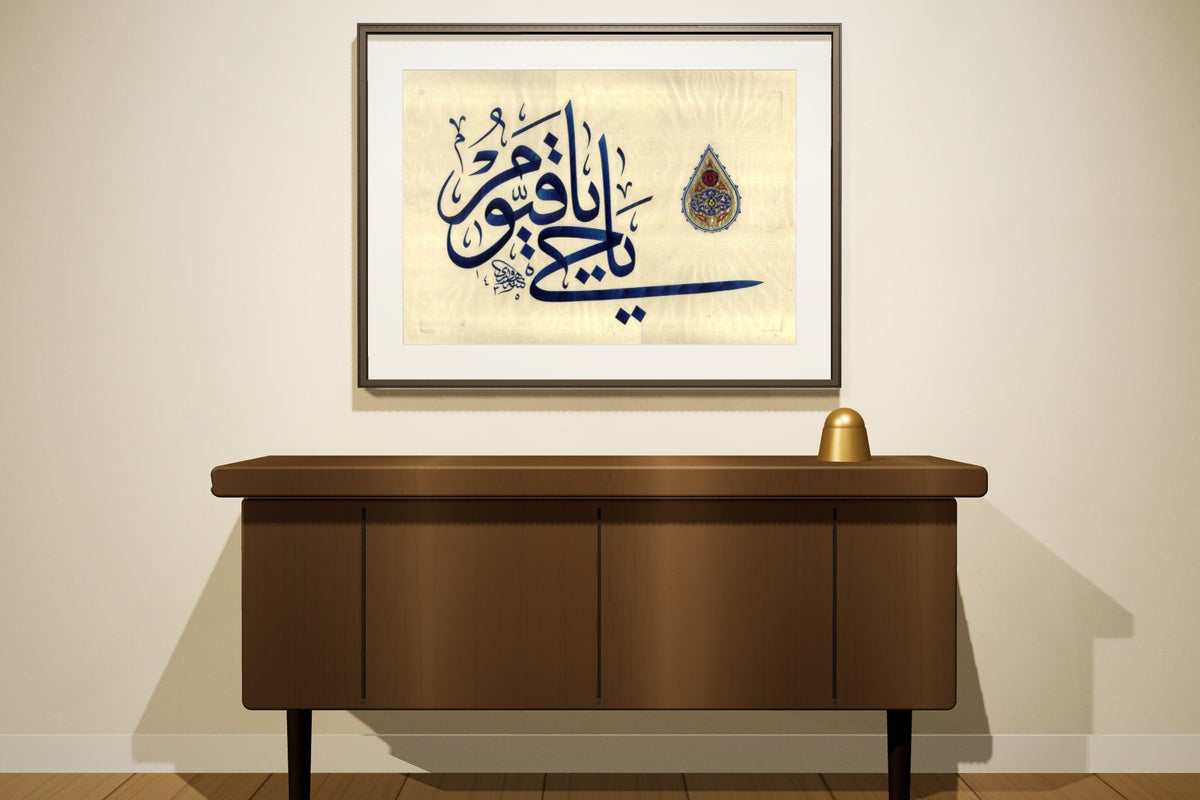
 «يا حي يا قيوم» — Ahmed Alhawary · Original
$2,166.28
 «فالله خير حافظاً» — Anwar Alhulwani · Original
$305.50
Why it is called the greatest verse
In Sahih Muslim 810, the Prophet ﷺ asked Ubayy ibn Ka'b which verse of the Book of God he held to be the greatest. Ubayy answered with its opening words, «اللَّهُ لَا إِلَٰهَ إِلَّا هُوَ الْحَيُّ الْقَيُّومُ», and the Prophet struck him on the chest and said, in meaning, "may knowledge bring you joy, Abu al-Mundhir". That report is why the verse is treated with particular honour, recited often, and hung in so many homes.
Where to put Ayat al-Kursi
- The majlis or the living room is the usual place: a wall people face when they sit.
- The entrance, opposite the door or above a console, so it is read on the way in.
- A study or an office, on the wall you face while you work.
As a courtesy, not a ruling: hang it at eye level or above, on a clean wall, never in a bathroom and never on or near the floor. Our guide to Qur'anic verses for the home covers these courtesies in more detail, and notes that scholars differ on hanging verses as decoration.
Size: why the full verse needs room
Ayat al-Kursi runs to about fifty words. Written in full on a small sheet, the letters shrink until the vowel marks blur, and from across a majlis it reads as texture rather than text. As a rule of thumb, give the full verse A2 (42 × 59.4 cm) at the very least, and A1 or larger for a wall you see from a sofa. A short excerpt can sit happily at A3.
So there are two honest choices:
- Its opening words, large. Our «الله لا إله إلا هو الحي القيوم» paint in Diwani carries the opening of Ayat al-Kursi only, not the whole verse. It is from AED 60 as a rolled A3 canvas, AED 100 framed at A3, AED 195 framed at A2, and AED 345 framed at A1.
- The whole verse, as a bespoke piece. We set the full text to your wall and size through custom calligraphy, and check every letter and vowel with you before printing. Our post on commissioning a bespoke piece explains the steps. You can also set it yourself in Mashq Studio, free, and order it as a paint.
Originals on the same words
For a piece written by a calligrapher's own hand, Ahmed Alhawary's «يا حي يا قيوم» calls on the two names that open Ayat al-Kursi, in Jali Thuluth in blue ink with a gold-leaf shamsa, 90 × 60 cm, AED 7,800; it is not in hand, so allow 3–4 weeks. Anwar Alhulwani's «فالله خير حافظاً», from Yusuf 12:64, carries the same idea of God's keeping: «فَاللَّهُ خَيْرٌ حَافِظًا ۖ وَهُوَ أَرْحَمُ الرَّاحِمِينَ», "God is the best guardian, and He is the most merciful of the merciful". It is ink on burnished paper, 65 × 65 cm, AED 1,100. Originals ship unframed; framing with glass in the UAE is a flat AED 300. More are in Qur'anic calligraphy.
Quick answers
Which verse is Ayat al-Kursi? Al-Baqarah 2:255, the verse that opens «اللَّهُ لَا إِلَٰهَ إِلَّا هُوَ الْحَيُّ الْقَيُّومُ».
Does your Diwani paint show the whole of Ayat al-Kursi? No. It carries the opening words only; the whole verse is made as a bespoke piece or set in Mashq Studio.
What size should a full Ayat al-Kursi frame be? A2 at the very least, and A1 or larger if it hangs on a wall seen from across a room.
Making and delivery
Paints are made to order in our workshop in 5–7 working days; UAE delivery is AED 50 per order. A rolled canvas also travels abroad by Worldwide Express, the shipping rate shown at checkout, within 8 days.
Keep reading: 43 Arabic Phrases for Wall Art, With Their Meanings · How to Choose the Size of an Arabic Calligraphy Painting · verses on faith in Mashq Studio.
About this guide: written by MASHQ, which makes Arabic calligraphy pieces to order in its UAE workshop (1click2open LLC, Sharjah). Verses are quoted from the Qur'an with their sura and verse, and the hadith from Sahih Muslim with its number. Prices were checked against the shop in October 2026.